About
My name is Ugo Lomoio, I'm a Biomedical engineer and now a PhD Student in Digital Medicine at the Magna Graecia University of Catanzaro. My research focus on Artificial Intelligence applications in healthcare.
I love computers, gaming, playing violin, listen to music while doing AI research.
During my three year PhD period I have joined the Department of Computer Science and Technology, University of Cambridge (UK) for my six month abroad period.
My PhD fellow was partially co-funded by Relatech S.p.A  where I worked for one year as a data scientist intern.

AI & Machine Learning & Network Science
After the Bachelor's degree in Informatic and Biomedical Engineering and the Master degree in Biomedical Engineering, both at University of Catanzaro, I decided to continue my studies with a PhD in Digital Medicine focusing on Artificial Intelligence in healthcare.
- Birthday: 22 July 1996
- Website: https://ugolomoio.github.io
- Phone: +39 388 3787548
- City: Catanzaro, Calabria, IT
- Age:
- Degree: Master degree in Biomedical Engineering
- Email: lomoiougo@gmail.com
Facts
I've been a computer enthusiast since young age, but i learned how to code only at 19 years old thanks to my University and thanks to the professor of the course in "Informatics Fundamentals", now my PhD supervisor, Pietro Hiram Guzzi.
Skills
Programming and Markup Languages
Python Libraries

Scikit-Learn

SciPy

PIL

Networkx

TensorFlow

PyTorch

TorchVision

Plotly - Dash
Matplotlib

Pytorch Lightning

NumPy

Pandas

Transformers

Diffusers

Torch Geometric

Graph Outlier Detection (pygod)
Cloud Services

Google Cloud Platform

Google Colaboratory
Databases and Other

Mongo DB

MySQL

RedCap

Apache Superset
Operating Systems

Windows

Linux

MacOs
Resume
I have a MSc in Biomedical Engineering. I'm now a PhD student in Digital Medicine that focus his research on developing and applying Artificial Intelligence models in healthcare.
I love computers, programming and AI. In my research i work on the development of AI models, and decision support systems softwares, to support clinicians in their daily work routine. I like learning and experimenting new things involving AI research. I'm a native Italian speaker with advanced English skills in reading, writing, understanding and speaking.
Summary
Lomoio Ugo
MSc in Biomedical Engineering
I'm particularly interessed in Deep Learning, Machine Learning and Network Science.
- Catanzaro, Calabria, IT
- +39 388 3787548
- lomoiougo@gmail.com
Education
Bachelor's Degree: Informatic and Biomedical Engineering
2016 - 2019
Magna Graecia University of Catanzaro, Italy
Thesis: "Italian normative for nuclear medicine sites"
Degree Score: 94/110.
Master's Degree: Biomedical Engineering
2019 - 2022
Magna Graecia University of Catanzaro, Italy
Thesis: "Sperimentation of network community detection algorithms for the analysis of Protein Contact Networks"
Degree Score: 110/110 with honors.
PhD in Digital Medicine
2022 - 2025
Magna Graecia University of Catanzaro, Italy
Thesis: "Cutting-edge explainable AI pipelines and models to study cardiac diseases"
PhD cofounded by Relatech S.p.A
PhD visiting scholar
September 2023 - February 2024
Department of Computer Science and Technology, Cambridge University, United Kingdom
PhD cofounded by Relatech S.p.A
Teaching activities
Teaching Assistant for the course of "Advanced Bioinformatics Techniques"
2022 - 2025
Magna Graecia University of Catanzaro, Italy
Assisting students in the course of Advanced Bioinformatics Techniques, providing support in Python programming and data analysis.
Teaching Assistant for the course of "Machine Learning and Artificial Intelligence"
2022 - 2025
Magna Graecia University of Catanzaro, Italy
Assisting students in the course of Machine Learning and Artificial Intelligence, providing support in Python programming and data analysis.
Experience
Data Scientist Intern at Relatech S.p.A, Rende, Italy
May 2024 - May 2025
Working on research related projects such:
- Agritech, Italian National Centre for the Development of new Technologies in Agriculture. Create and maintain the SQL database to save 10 years of weather measurements from multiple sensors located in the Tuscany region of Italy. Create interactive dashboards for sensor data visualization and analysis. Implement dashboards for the analysis of production data, operational efficiency and technological adoption as reported by national agricultural enterprises;
- InMoto, home rehabilitation for patients suffering from neuromotor pathologies and neurocognitive diseases. Developing dashboards and interactive demonstrations to visualize health data collected from wearable devices such as Fitbit and Whoop. Designing a demo for analysing patient movement trajectories using coordinates captured by a wheeled walker. Contributing to the planning of the project’s end-to-end workflow, encompassing data acquisition, cloud transmission, and final analysis.
Multiple occasional self-employment contracts as a Research Collaborator for the PON VQA project at UNICZ:
February - July 2022
:
Working on the development of the PCN-Miner tool, a Python-based GUI for Protein Contact Networks analysis. Available at: https://github.com/hguzzi/ProteinContactNetworks- Applied to COVID-19 research: SARS-CoV-2 Spike protein analysis for drug design
- 16 citations in bioinformatics community, widely adopted tool
- Unified fragmented tools into single end-to-end Python pipeline
- Identifies allosteric drug targets and predicts mutation impacts
- Open-source on PyPI and GitHub for community use
- Published in Bioinformatics (Oxford University Press), 2022
August 2022 - January 2023
:
Working on the development of the first explainable decision support system tool for ECG anomaly detection in holter signals. Available at: https://github.com/UgoLomoio/ECG_DSS_CAE- 99.75% accuracy detecting heart anomalies in real-world data
- Deployed for 24-hour continuous monitoring applications
- Supports physicians in identifying cardiological risks and pathologies
- Explainable AI: Transparent results validated by cardiologists for clinical trust
December 2023 - June 2024
:
Developing the demo tool for the final PON VQA project, writing documentation and user manuals. Developing also various systems for clinical data management for internal hospital usage using MySQL and RedCap.- Project demo and documentation that successfully passed the ministerial evaluation
Key contributions:
Key findings:
Key contributions:
Reviewer for the following journals\conferences:
- BMC Bioinformatics
- IEEE Transactions on Computational Biology and Bioinformatics
- Frontiers in Digital Health
- Workshop of Networks and Graph Neural Networks for Bridging Bioinformatics and Medicine, CIBB2025
- Computational and Structural Biotechnology Journal
- Journal of Healthcare Informatics Research
- LLMs and Graph Neural Networks for computational biology and medicine Workshop, IEEE BIBM 2024
Workshop Organizer \ Program Committee:
- Workshop Programme Committee at IEEE BIBM 2024. Workshop of “LLMs and Graph Neural Networks for computational biology and medicine”
- Workshop organizer at CIBB 2025. Workshop of “Networks and Graph Neural Networks for Bridging Bioinformatics and Medicine”
- Workshop organizer at IEEE BIBM 2025. Workshop of “Network Science and Artificial Intelligence for Biomedicine & Health informatics”
Scientific societies membership:
- IEEE Student Member, from 2023
- Bioinformatics Italian Society (BITS), from 2025
- Italian National Group of Bioengineering (GNB), from 2023
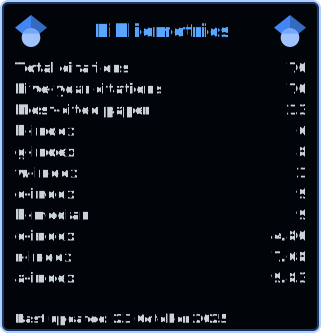
Research Metrics:
Portfolio
Quite all of my projects are publicly available on GitHub, here you can find a list of them.

PhD project research
Study, definition and implementation of innovative techniques for the analysis of medical clinical data.
During my PhD I worked on multiple research explainable AI-related projects aimed to improve the analysis of medical clinical data, here you can find a list of them with a brief description.
GTex Visualizer
An open source, cloud-based, web application for the analysis of gene expression data in the GTex database to study changes in gene expression ralated to aging and diseases.
ECG Decision Support System
An open source and offline Decision Support System tool for the analysis, automatic identification of abnormalities and annotation of 12-lead ECG signals. The anomaly detection task is performed using an AutoEncoder model trained to reconstruct 2-seconds lenght healthy ECG windowsof. Trained and tested using both synthetical generated data and real ECG signals from the PTB and PTB-XL datasets. The tool provides a user-friendly interface for clinicians to upload and analyze ECG signals. Once the ECG signal is uploaded, the tool automatically detects and shows them to the clinician for the final annotation. Explanations of the prediction are provided to increase clinician trust so they can perform the final annotation.
SARS CoV 2 Spike protein variants analysis trough Protein Contact Networks (PCNs)
PCN-Miner is our open source and offline tool for the analysis of protein structures based on the concept of PCN. A PCN of a given protein is a graph rappresentation of the protein structure. In our research, we constructed and analyzed the PCNs of the SARS CoV 2 Spike variants. Then, we compared our results (for example: aminoacid/node centralities, network communities) to find differences between variants.Comparing Kolmogorov-Arnold Network Autoencoders against vanilla ones
In this work we compared the performance of Kolmogorov-Arnold Network Autoencoders (KAE) against vanilla Autoencoders (AE) in the analysis of biomedical data. Both linear and convolutional autoencoders were trained and tested on the same datasets. We used a dataset of stetoscopic heart sounds and compared both models for multiple tasks: reconstruction, denoising and inpainting. We found that convolutional KAEs with PixelShuffle layers outperformed all the other models in all tasks.Key findings:
- Novel AI architecture: First application of Kolmogorov-Arnold Networks (KANs) to medical signal autoencoders
- Outperformed standard CNNs on cardiac audio analysis across 3 tasks: reconstruction, denoising and inpainting
- Best efficiency: Lowest reconstruction error with smallest parameter count among tested architectures
- Applied to AbnormalHeartbeat dataset with stethoscope audio signals for clinical diagnostics
- Demonstrated clear class separation (normal vs. abnormal) in unsupervised latent space learning
Transthyretin
We proposed a new approach to study the transthyretin protein (TTR), a protein involved in amyloidosis. Given the low availability of experimental structures of TTR in the tetramer conformation, we focused on computational methods to model the protein using AlphaFold 3. Predicted structures were validated against experimental data when available A total of 133 TTR mutations were analyzed using various computational tools.Methods used:
- Structural analysis of the protein using Protein Contact Networks (PCNs) was used to identify central residues and functional domains.
- We computed TM-scores between each variant and wild-type TTR to assess their structural similarity.
- We used ESM2 embeddings and UMAP to visualize the variants distribution in a 2-dimensional space: benign mutations were found near the wild-type TTR, while pathogenic variants were found in more distant regions.
- We also performed tafamidis ligand optimization and de-novo ligand generation using DiffSBDD: optimization increased binding affinity, generation gives best QED drug-likeness.
- We performed docking and binding affinity prediction of the transthyretin protein with its ligands using AutoDock Vina and DiffDock.
- We performed 100-ns molecular dynamics simulations of the V50M TTR variant to study its stability and the stabilizing effects of each ligand.
Key findings:
- Published in Nature: npj Systems Biology and Applications, September 2025
- Analyzed transthyretin (TTR) mutational landscape for drug design in amyloidosis treatment
- Integrated structural profiling across multiple TTR mutations to optimize ligand binding
- Combined computational modeling with drug optimization for precision medicine approach
- Addresses TTR amyloidosis, a disease affecting heart and nerves with limited treatment options
- Contributes to rational drug design pipeline for rare genetic diseases
E-ABIN
We proposed a new tool to analyze gene expression data from the gene expression omnibus (GEO) database. E-ABIN is an explainable module for anomaly detection in biological networks, incorporates both machine and deep learning techniques to perform anomaly detection in gene expression and dna methylation datasets. The tool was evaluated on several benchmark datasets (celiac disease, parkinson, bladder and colorectal cancer), demonstrating its effectiveness in identifying anomalous patterns and providing insights into the underlying biological processes. An explainability module is available to provide different level of explanations (most influential genes for the prediction of the abnormal class): from patient level to dataset level. Most influential genes found using E-ABIN align with known disease-related genes, demonstrating the tool's potential for identifying novel biomarkers and therapeutic targets.Key findings:
- First-of-its-kind platform: Only tool combining GUI, ML/DL models, explainability, and DNA methylation analysis in one framework
- Perfect accuracy (100% AUC) on colorectal cancer detection, validated on 146-sample dataset
- Identified 7 cancer-relevant genes in bladder cancer including RUNX2, ITGB3, CARD8 validated by medical literature
- Production-ready GUI: Accessible to non-programmers, eliminating technical barriers for clinical researchers
- Outperformed other tools across multiple benchmarks (0.73 vs 0.59 AUC on celiac disease dataset)
- Published in NAR Genomics and Bioinformatics (Oxford University Press), December 2025
ExDiff
A modular and explainable framework combining network simulation and graph neural networks to study spreading dynamics in complex networks. The framework allows to simulate the spreading of a disease in a network, and then to use graph neural networks to learn the patterns of the spreading. The SIRVD model is used to simulate the spreading of a disease in a network, where nodes represent individuals and edges represent interactions between them. The framework is modular and can be easily extended to include other spreading models (e.g., SIR, SIS).Real case studies:
- Simulation of west-nile virus spreading in both synthetic and real multispecies populations (human, birds and mosquitos) using simulation parameters estimated from italian bulletins.
- Simulation of COVID-19 spreading on both synthetic and real human populations using early and late stage parameters estimated from italian bulletins.
- Simulation of Monkeypox (Mpox) spreading in multispecies population (human and rodent) using parameters from Nigeria and Congo.
- Simulation of measles spreading in human populations using parameters from historical outbreaks in Italy.
Key findings:
- In Monkeypox, targeted vaccination, togheter with quarantine and rodent culling, is the most effective strategy to control the spreading of the disease. With culling having more effects in the early stages of the epidemic.
- In COVID-19, early vaccination of high-risk individuals (nodes with high centrality) and social distancing are key to control the spreading of the disease. With social distancing having more effects in the early stages of the epidemic.
- In Measles, we used XAI ExDiff predictions to guide vaccination and quarantine. XAI guided vaccination improved the effectiveness of vaccination campaigns, by reducing the infection peak from 33.25% (vaccination guided by node centrality) to 10.50% (XAI guided vaccination).
DCAE-SR
A deep learning model that reconstruct electrocardiogram (ECG) signals at super resolution. The model is trained on a large dataset of ECG signals (PTB-XL dataset) and is able to reconstruct the ECG signal at a resolution of 500Hz, while the original signal is sampled at 50Hz and corrupted by ECG artifacts such as EMG, baseline wander, and noise. The model is based on a denoising convolutional autoencoder (DCAE) architecture and explainability techniques are used to undestand the impact of each sample of the signal for the final super-resoluted signal. Performances are evaluated in terms of MSE, RMSE, PSNR and SSIM. Down-stream tasks such as classification shows that applying super-resolution leads to improved classification performance when compared against the interpolation of the original signal.Key findings:
- Super-resolution innovation: First denoising autoencoder for ECG super-resolution, enhancing low-quality signals for better diagnosis
- 12 citations since 2024 publication in Artificial Intelligence in Medicine (Elsevier, high-impact journal)
- Dual decoder architecture: simultaneously reconstructs clean signals AND generates denoised high-resolution versions from noisy data
- Validated on PTB-XL dataset with superior performance over existing ECG super-resolution methods
- Clinical applications: Arrhythmia detection, microvolt T-wave alternans analysis, cardiac event identification
- Open-source on GitHub with pretrained models for immediate deployment in medical monitoring systems
- Using Explainability techniques to interpret how model performs super-resolution
- Observerved semantic patterns in the latent space learned by the model
Publications
Here you can find a list of my publications in peer-reviwed scientific journals and conferences.
Search Publication
Conference Procedings
- Puccio B., Lomoio U., Di Paola L, Guzzi P.H. and Veltri P. (2022). Annotating Protein Structures for Understanding SARS-CoV-2 Interactome. SEBD 2022. SEBD 2022 Presentation.
- Giancotti R., Lomoio U., Veltri P., Guzzi P. H., & Vizza P. (2022). A machine-learning based tool for bioimages managing and annotation. 2589–2594. IEEE BIBM 2022.
- Guzzi P. H., Lomoio U., Scicchitano R., & Veltri P. (2022). NOMA-DB: a framework for management and analysis of ageing-related gene-expression data. 1905–1910. IEEE BIBM 2022.
- Guzzi P. H., Lomoio U., & Veltri P. (2022). Enabling analysis of transcriptomic data related to Ageing Processes through the GTEx-Visualizer web portal. BBCC 2022 Poster.
- Guzzi P. H., Cannistra M., Giancotti R., Lomoio U., Puccio B., Vizza P., … & Veltri P. (2023). Annotating omics Data with sex and age of samples: Enabling powerful omics studies. 3886–3890. IEEE BIBM 2023.
- Puccio B., Lomoio U., Giancotti R., Cannistra M., Flesca S., Scala F., … & Vizza P. (2023). Validating biomedical and clinical data via an annotations based framework: experiences within the PON VQA project. Patron Editore Srl. GNB 2023 Poster.
- Lomoio U., Vizza P., Giancotti R., Tradigo G., Petrolo S., Flesca S., … & Veltri P. (2023). A tool to perform semi-supervised anomaly detection and annotation on 15 lead ECG signals. Patron Editore Srl. GNB 2023 Poster.
- Guzzi P. H., Lomoio U., Mazza T., & Veltri P. (2024). Anomaly Detection in Individual Specific Networks through Explainable Generative Adversarial Attributed Networks. 5764–5769. IEEE BIBM 2024.
- Lomoio U., Defilippo A., Puccio B., Guzzi P.H., & Veltri P. (2025). A Framework based on Explainable Graph Neural Networks For Modelling Spreading Processes in Networks. GNB 2025 Poster.
- Puccio B., Defilippo A., Lomoio U., Scalise S., Parrotta E.I., Veltri P., & Guzzi P.H. (2025). Network Modeling and Graph Neural Networks for Integrating Single-Cell and Bulk RNA-seq in Disease Progression. BITS 2025 Poster.
Journal Articles
- Lomoio U., Veltri P., Guzzi P. H., & Liò P. (2025). Design and use of a Denoising Convolutional Autoencoder for reconstructing electrocardiogram signals at super resolution. Artificial Intelligence in Medicine, 160, 103058.
- Lomoio U., Vizza P., Giancotti R., Petrolo S., Flesca S., Boccuto F., … Tradigo G. (2025). A convolutional autoencoder framework for ECG signal analysis. Heliyon, 11(2).
- Guzzi P. H., Di Paola L., Puccio B., Lomoio U., Giuliani A., & Veltri P. (2023). Computational analysis of the sequence-structure relation in SARS-CoV-2 spike protein using protein contact networks. Scientific Reports, 13(1), 2837.
- Guzzi P. H., Lomoio U., Puccio B., & Veltri P. (2022). Structural analysis of SARS-CoV-2 Spike protein variants through graph embedding. Network Modeling Analysis in Health Informatics and Bioinformatics, 12(1), 3.
- Guzzi P. H., Lomoio U., & Veltri P. (2023). GTExVisualizer: a web platform for supporting ageing studies. Bioinformatics, 39(5), btad303.
- Lomoio U., Puccio B., Tradigo G., Guzzi P. H., & Veltri P. (2023). SARS-CoV-2 protein structure and sequence mutations: Evolutionary analysis and effects on virus variants. PLoS One, 18(7), e0283400.
- Giancotti R., Lomoio U., Puccio B., Tradigo G., Vizza P., Torti C., … Guzzi P. H. (2024). The Omicron XBB.1 variant and its descendants: genomic mutations, rapid dissemination and notable characteristics. Biology, 13(2), 90.
- Lomoio U., Carbonari V., Giorgi F.M., Ortuso F., Liò P., Veltri P., & Guzzi P.H. (2025). Integrative Structural Profiling and Ligand optimisation Across the Transthyretin Mutational Landscape. npj Syst Biol Appl 11, 104 (2025).
- Lomoio U., Mazza T., Veltri P., Guzzi P.H. (2025). E-ABIN: an Explainable module for Anomaly detection in BIological Networks. NAR Genomics and Bioinformatics, Volume 7, Issue 4, December 2025, lqaf135.
Currently under revision:
- Defilippo A., Lomoio U., Puccio B., Veltri P., Guzzi P.H. (2025). ExDiff: A Framework for Simulating Diffusion Processes on Complex Networks with Explainable AI Integration. Second round review at Social Network Analysis and Mining.
- Branda F., Ceccarelli G., Ciccozzi M., Scarpa F., Lomoio U., Chiodo F., Veltri P., & Guzzi P.H. (2025). Comparing Epidemics Controls through Simulations and Explainable Graph Convolution Networks. On Review at Scientific Reports Nature.
- Branda F., Defilippo A., Lomoio U., Puccio B., Ciccozzi M., Scarpa F., Veltri P., and Guzzi P.H. Deep Learning-based Malaria Parasite Image Classification on Real Microscopy Data.
- Branda F., Defilippo A., Lomoio U., Puccio B., Ciccozzi M., Scarpa F., Veltri P., and Guzzi P.H. From Data to Decisions: A Modular Platform for modelling and Simulation of Infectious Disease Diffusion in Networks. Second round review at BMC Medical Informatics and Decision Making.
- Lomoio U., Veltri P., Guzzi P.H. Comparing Kolmogorov-Arnold Network Autoencoders against vanilla ones in biomedical data analysis. On Review at Journal of Computational Science.
Contact
Location:
Catanzaro, Calabria (IT), 88100
Email:
lomoiougo@gmail.com
Call:
+39 388 3787548